
Progress Update June 2025

Progress Update
June 2025
Dear <<First Name >>,
Welcome to the M28 Cork to Ringaskiddy Project newsletter. We are happy to keep you informed as this major project begins. Through regular updates, we’ll share key milestones, ongoing works, traffic management information, and project highlights to keep you up to date with progress on site.
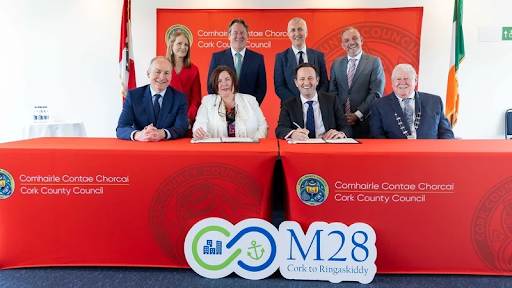
Cork County Council has officially signed a €206 million construction contract with BAM for the M28 Cork to Ringaskiddy Motorway, marking a major milestone in the overall project. This vital infrastructure will deliver 11km of new motorway, enhancing connectivity between the Bloomfield Interchange and Barnahely. Works are already underway on the 1.5km Relief Road at Ringaskiddy, being delivered by Sorensen Civil Engineering as an early element of the overall scheme. Funded by the Department of Transport through TII, the M28 Cork to Ringaskiddy Project will support the Port of Cork’s expansion at Ringaskiddy, ease congestion, and improve safety and journey times for commuters and commercial traffic. Expected to be completed by summer 2028, the project is part of the EU’s Trans-European Transport Network and a key element of Project Ireland 2040.

Upcoming Works and Site Activity Update from BAM
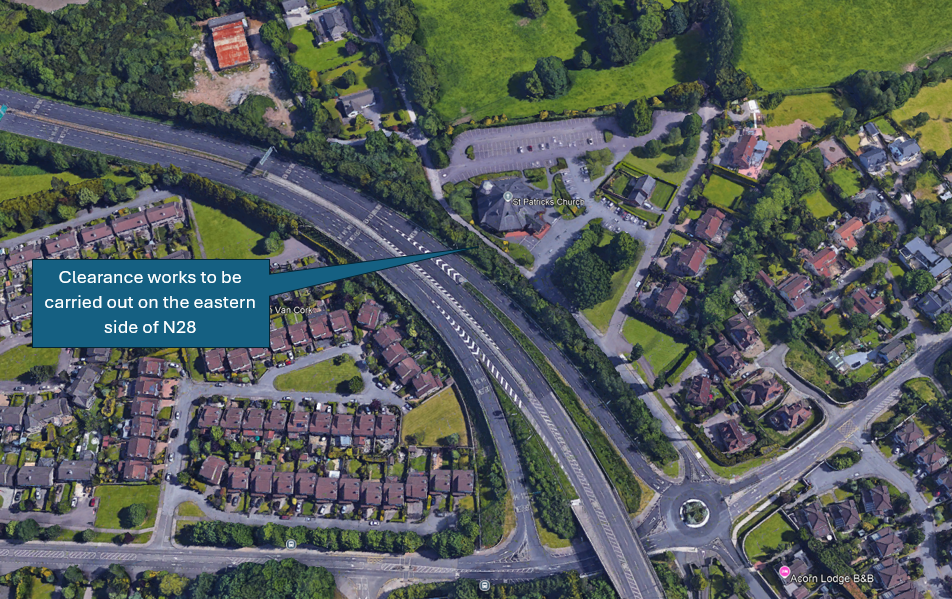
As part of the early phases of the M28 project, BAM will commence site clearance works around St. Patrick’s Church in Rochestown (see image above) towards the end of June, with ducting works to follow in the same area. Ecology surveys are currently ongoing across the entire project site to ensure environmental compliance and protection. This week also marks the start of overhead line protection works and the erection of general site safety signage. Earthworks will also commence this month initially along the Barnahely to Shannonpark section. Meanwhile, BAM is actively establishing site compounds and finalising key design elements to prepare for the main construction phase.
Protecting Nature and Waterways
As part of our commitment to protecting the environment, several early measures have already been put in place. To support local wildlife, artificial badger setts and bat boxes have been built to replace those affected by the works. To protect nearby rivers and streams, silt curtains have been installed to prevent sediment from entering the water. Water quality is being carefully monitored through stations equipped with auto-samplers, which collect data in all weather conditions. Turbidity alarms are ready to alert the team if levels rise, and cameras have been installed at each watercourse, with live feeds streamed to the site office. Some compensatory planting has already taken place, with native trees and shrubs added to help maintain the area’s natural character. Further planting will take place during the main works, using only native species such as Hybrid Oak, Scots Pine, Hawthorn, Hazel, Holly, Blackthorn, Birch, and Grey Willow. These are just some of the steps taken so far as part of our strong focus on environmental compliance and nature conservation.
Uncovering Cork’s Ancient Past
Archaeological excavations along the M28 have revealed a rich history stretching back over 5,700 years. Discoveries include a rare Neolithic house, Bronze Age dwellings and cremation sites, early and late medieval settlements, and the remains of a 17th-century forge — possibly Cork’s earliest roadside service station. These findings offer a unique glimpse into the lives of past communities, from the first farmers to medieval metalworkers. Excavations across 38 sites have been carried out by a dedicated team of archaeologists, with further research ongoing. This work reflects our strong commitment to preserving and understanding the cultural heritage of the Ringaskiddy Peninsula and wider Cork region. More in-depth details on findings across the scheme will be available on our project website.
Advance Works – Early Preparations in Place
In recent years, a comprehensive programme of advance works has been delivered along the M28 Cork to Ringaskiddy Project corridor. These works included early utility diversions—such as ESB, gas, and watermain installations—along with site clearance, fencing, and masonry wall construction. Haul roads have been established, and several embankments pre-constructed. The main project office was also set up in Shanbally during this phase, ensuring everything was in place for the main contractor to mobilise efficiently. These advance works laid the foundation for the main construction phase, helping to reduce risk, streamline logistics, and support efficient project delivery.